



Technology3

Future Ring, Space link
Technology3(T3): is the methodology of TROGRESS® for innovation and development across three key domains(MFO): M (Motion), F (Flow), and O (Other). The M (Motion) domain focuses on developing a new, innovative generation of motion technologies—such as Motor3, Engine3, jet engine3, and others, in addition to motion transmission systems or what so-called transmission3. The F (Flow) domain focuses on developing a new, innovative generation of flow technologies, such as pump3, compressor3, vaccum3, turbine3 and others. Meanwhile, the O (Other) domain entails developing innovative technologies in diverse fields, such as the "Building3 System" in construction and others. Applications of "T3" span a wide range of sectors, including water, energy, the environment, construction, food, transportation, space and others.
The "M-F" (Motion-Flow) specialization represents the core of "T3"—which draws upon innovative concepts and principles such as Free Motion®, Free Forces®, and High Centrifugation®—in the development and innovation of high-efficiency, high-performance motion-flow systems (characterized by high speed S, torque T, and flow Q). These systems, which we term "Systems3," may represent a "missing link" that is urgently needed to reshape our lives and our sustainable future.
What is the importance of T3 and high-efficiency, high-performance Systems (System3)?
Its significance stems from achieving high technical performance through three key technical concepts or objectives: productivity, effectiveness, and efficiency:-
-Technical Productivity (Technical Abundance)—combined with high speed or torque: This entails an abundance of resources such as water, energy, food, transportation, etc.
-Technical Effectiveness—combined with high speed and torque: This involves unlocking and opening up new, exceptional technical horizons and capabilities that were previously inaccessible.
-Technical Efficiency—with less energy: This entails achieving high energy efficiency, potentially exceeding 99% of current standards.
Furthermore, T3 offers significant technical advantages due to its inventive structural design, including:
-Simplicity: with simple and uncomplicated structure.
-Scalability: Capability to cover a wide range of scales, from small to massive (e.g., highly viable construction of equipment such as pumps with diameters exceeding 10 meters).
-Stability: Ability to operate under extremely harsh conditions and environments (high Speed-Torque and Flow Q).
How does it work?
T3 operates according to the FST-MGQ methodology—or what we call the "Fast-Magic methodology"—as shown in the following general diagrams:
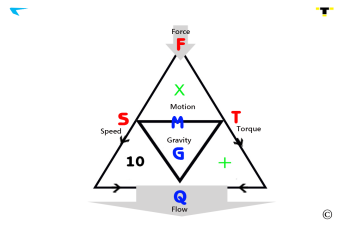
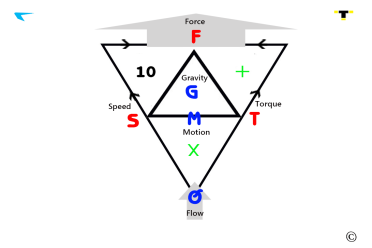
The FST-MGQ framework comprises three "FST" parameters—Force (F), Speed (S), and Torque (T), known as motion parameters—and three "MGQ" principles—Motion (M), Gravity (G), and Flow (Q), known as motion-flow principles.
The FST motion parameters are interconnected through close physical relationships in the following general equation:
Fg=(S*T)*0.1047
Fg = general forces (energy) , measured in watts
S = Speed , measured in RPB
T = Torque , measured in N.m
c = constant with a value of 0.1047
From it, the well-known speed-torque (S-T) relationship, characterized by an inverse physical link (as one increases, the other decreases, and vice versa). In physical reality, this inverse relationship makes it difficult to advance the development of systems requiring high speed (S), torque (T), and—consequently—flow (Q), despite our urgent need for them. Through its innovative methodologies and technologies, "T3" employs MGQ motion principles to manage and reconfigure these relationships. For instance, the principles of Motion (M) and Gravity (G)—collectively termed the "Free=Motion (FM)®" principle—work to decouple the link between speed and torque, allowing them to operate independently or even in a direct relationship (where an increase in one leads to an increase in the other). This results in high-performance, free flow (Q)—characterized by high torque and speed—and enhanced energy efficiency by liberating force (energy) and realizing the concept of "Free Force (Energy) F3." Consequently, the general equation shifts from a multiplicative to an additive model, yielding a new formula known as the " Equation3" or the "Free Force (Energy) Equation" , as follows:
F3=(S+T)*R
Where:
F3 = New/Free Forces (energy) , measured in watts
S = Speed , measured in RPB
T = Torque , measured in N.m
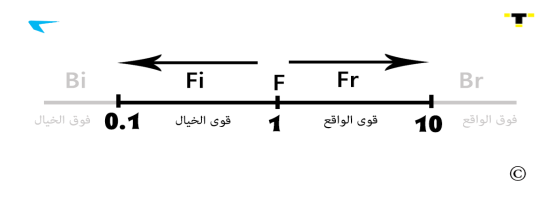
R = Range of Forces(energy) between 0.1-10 . .
Range R:
In the preceding equation, the variable R represents a range from 0.1 to 10—termed "Free Power (Energy) Range R"—which situates us between two types of forces: forces of reality and forces of imagination. The value 1 marks the midpoint of this range and serves as the basis for calculating the fundamental free Force (energy), F3. If the power (energy) increases and shifts toward the right (within the range), it is classified as a force of reality (Fr); conversely, if the value decreases and shifts toward the left (within the range), it is termed a force of imagination (Fi). If the value exceeds the range to the right, it is designated as "over-reality" power (Br), whereas exceeding the range to the left results in "over-imagination" power (Bi), as the following:
Example:
If we have a simple motion system (motor) with a speed of 1000 rpm and a torque of 100 N.m, what is the magnitude of the general force Fg and the free force F3 required?
The solution
Calculating general force (energy) Fg:
Fg=S*T*0.1047=1000*100*0.1047=10.000watt
Fg=10Kw
Calculating free forces (energy) F3:
F3=(S+T)*1=1000+100=1100watt
F3=1.1Kw
To calculate the range of free forces R
R=F3*10-F3*0.1=11Kw-0.11Kw
Explanation: The general force (energy) Fg required is 10 kilowatts, while the free force (energy) F3 required is 1.1 kilowatts, meaning an energy efficiency of about 90%. But according to the range R, the free forces (as a reality force) may reach up to 11 kilowatts, that is, even greater than the general (energy) forces. On the other hand, they may decrease (as an imaginary force) up to only 0.11 kilowatts (this depends on the structure and efficiency of System3).
Systems 3 between the forces (energy) of reality and imagination:
The system's use of energy may vary between realistic and imaginary forces. For example, the system may require starting-energy to start from rest, which may be large, and thus depends on free forces F3 or realistic Fr, but when the system gains momentum and stabilizes, that energy may be reduced to running energy, and thus it may operate with free forces (F3) or even imaginary Fi.
Barrier of 10.000 (The next challenge):
The number 10.000 represents an important technical/physical barrier, also so-called TPB(10.000) , which represents the next technical challenge and Technology3 targets it by high-performance systems with high speed S, torque T, and flow Q, more than 10,000 RPM, N.m, m3/s/m/h/d. It is also considered a standard that divides technologies into two groups, normal technologies that work before it, and powerful technologies that work beyond it, as follows: -
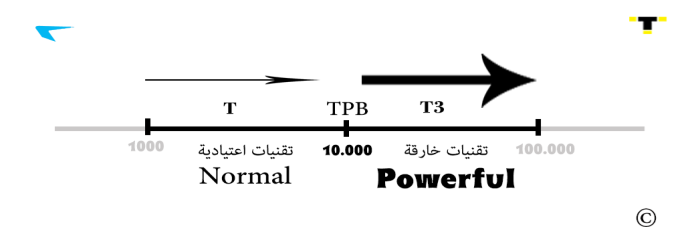
It is worth mentioning that barrier of 10.000 represents a technical obstacle that is less and more difficult to overcome in the general (current) situation. For example, we may find a motion system (as motors) whose speed exceeds 100,000 rpm, but its torque will be very weak (taking into account the small scale/size with increasing speed S). Conversely, we may find, for example, a motor with a high torque exceeding 50,000 N.m, but its speed will be very slow (taking into account the large Scale/size with increasing torque T), and it is also very difficult (and even impossible) to find a high-torque-speed motor (especially beyond the barrier of 10.000), for example, operating at a speed of 40,000 rpm and a torque of 80,000 N.m, which from a T3 point of view represents “technical gaps” called the S-T speed-torque gap, and it is working to bridge it through its methodology, concepts, and innovative techniques not Only to overcome barrier of 10.000 easily, but also to work very efficiently beyond it, as we will see through the coming examples/applications.
Differential Energy (DE):
The term differential energy (surplus energy) in T3 expresses the difference of forces (energy) Δ F between the general force (energy) Fg (from the general equation) and the free force (energy) F3 (from the second free energy equation) as follows:
ΔF = Fg – F3
Example 1:
If we wish to build a high-performance system operating at 10,000 RPM with a torque of 20,000 N·m, we face a significant challenge requiring great Force (Energy), calculated by the general equation:
Fg = 10,000 × 20,000 × 0.1
Fg = 20,000,000 Watts
Fg = 20,000 kW
In contrast, "T3" offers an innovative solution, and by free forces(energy) equation, as follows:
F3 = (10,000 + 20,000) × (1)
F3 = 30,000 Watts
F3 = 30 kW
To calculate the range:
R = 300 kW – 3 kW
Explanation: While the general scenario presents a major challenge requiring high Force (Energy)—approximately 20,000 kW (20 MW)—along with associated technical issues like excessive heat and stress, the "T3" solution requires only about 30 kW of free force(energy) F3. This figure may rise to 300 kW as real force (Fr) or drop to 3 kW as imaginary Force (Fi), all while entailing fewer technical issues regarding heat and stress.
Example 2:
If we wish to go further and build a high-performance system with capabilities exceeding those of the system in the previous example—for instance, operating at a speed of 20,000 RPM and a torque of 100,000 N·m—we would face a massive challenge. Calculating this using the general equation would be difficult (and technically perhaps impossible). Therefore, the only remaining option is to use "T3" and calculate the free forces(energy) as follows:
F3 = (20,000 + 100,000) × (1)
F3 = 120,000 watts
F3 = 120 kW
And the R range:
R = 1,200 kW – 120 kW
Explanation: This example, along with the previous ones, demonstrates the efficiency of T3 in operating beyond "Barrier of 10.000."
A question may arise here: Do we actually need such high-performance systems (characterized by high speed, torque, and flow)?
The answer is yes; they are a reality in our lives, and we need to advance them further for our future—and it will become clearer through the following applications.
Real applications (challenge3 and solution3):
High-performance super systems (high speed S- torque T- flow Q) are considered a reality in our lives. They are used in various applications, including in energy and high propulsion, such as in aircraft and ships. With the global trend of moving towards cleaner and more sustainable energy sources (and the increasing role of electrical energy in our lives at the expense of other energies such as combustion energy), we find ourselves facing a technical problem that reaches the point of technical impossibility, as we saw in the previous examples, and how T3, through its innovative technologies and concepts, was able to provide the solution, which we will discuss here with three important applications in Our life is a plane, a ship, and a giant energy turbine, as follows:

1- The plane:
A breakthrough technology capable of flying with a payload of up to hundreds of tons, with jet engines characterized by:
- S speed = 10,000-24,000 rpm.
- Torque T = 100,000-350,000 N.m
- Flow Q = 1,000-10,000 m3/s
Challenge3 (Challenge from a T3 point of view):
The plane's engine operates at a super speed S, as we have seen, working beyond the 10.000 barrier, with a high torque T of up to 350,000 N.m, but the challenge here lies in that these super powers result from burning large amounts of fuel (with a huge emission) to generate the high Q flow necessary to achieve propulsion.
Solution3 (Solution from a T3 point of view):
When talking about clean engines or fully electric engines, T3 provides solutions through projects such as the Airplane3 and the Jet Engine3 and through its innovative motion-flow systems to generate high performance (speed-torque-flow) with high energy efficiency, which the free force (energy) F3 required for a giant engine with a speed of 15,000 rpm and a torque of 350,000 N.m, is estimated at about 365 kilowatts, and it is also possible to go further than that. With the forces of reality and imagination, as the plane takes off, the need for starting-energy is large, meaning the need for free forces (F3) or realistic (Fr), but after take-off and reaching a stable running-energy, the energy consumption decreases, reaching perhaps the imaginative forces (Fi) that may reach in our example up to 36.5 kilowatts, making perhaps the dream of a clean plane closer than ever before.
2- Ship:
A breakthrough technology capable of sailing with a payload of up to hundreds of thousands of tons, with engines characterized by:
- Speed S = 50-100 rpm (slow).
- Torque T = 7,000,000 - 7,600,000 Nm (high)
- Flow (for propulsion) Q = 50 - 150 cubic meters per second (high).
Challenge 3:
The ship's propulsion system focuses on generating enormous torque, as we have seen, reaching up to millions of Newton meters in order to slowly rotate the giant propeller wheel outside the ship, relying on giant combustion engines that consume huge amounts of fuel (which represents a major environmental and economic challenge).
Solution 3:
T3 is working through Ship3 (Ship of the Future) project to develop a high-performance integrated propulsion system (high speed - torque - flow) that achieves high efficiency and feasibility, which may make the Propeller propulsion system (which is about 200 years old) a part of the past.
3- Giant energy turbine:
Giant power turbines are considered one of the extraordinary applications of motion and flow, including giant hydropower turbines in large dams that are capable of producing power up to 700 megawatts, as follows:
- Speed S = 75 rpm.
- Torque T = 130,000,000 N.m.
- Flow Q = 950 cubic meters of water per second.
Challenge 3:
The huge flow Q of water (which is close to 1000 cubic meters per second) is used to achieve huge torque to rotate the turbine (at slow speed), which generates huge electrical energy (close to 1000 megawatts = 1 gigawatt) that can be calculated from the general equation:
F=S*T*0.1=75*130,000,000*0.1=975,000,000watt=975,000Kw=975Mw
The efficiency of the turbine determines the actual energy produced, as the efficiency in this example is estimated at about 70%. The inverse "Speed-Torque" relationship be also shown clearly, as the slow S-speed required a huge torque T. This can also be compared with other types of turbines, such as:
- Steam turbine (with high-speed), which operates at a speed of 1,500 RPM and an absolute torque of 6,500,000 N.m.
- Gas turbine (with ultra-speed), which operates at a speed of 3,000 rpm and an absolute torque of 3,250,000 N.m.
The big challenge here lies in these imaginary water flows and huge structures (such as giant and expensive dams), which may not be available or possible in many countries around the world.
Solution 3:
Technology3, through the Energy3 projects and Newables®, and through its innovative technologies and concepts, works to control and reformulate the relationships of speedS-torqueT-flowQ to build new and innovative energy applications (with high efficiency), including closed hydropower applications such as mountain energy projects , Turbine-O and High-efficiency Turbine3, which operate with few water resources and simple structures that make them available, potential, and applicable solutions in many places around the world.
T3's Philosophy (Physics3):
The philosophy of technology3 is not based on what might be thought to be a breakthrough into physics or breaking its laws such as “law of energy conservation.” Rather, it is based on physics3 or physical innovation (By using physics to overcome the obstacles of physics).
let's use physics3!
Here we provide a simple example to clarify some technical concepts, such as the concept of free motion (and the speed-torque relationship), and the difference between free and restricted forces (systems). Let us assume a motion system consisting of a large central gear, driven by 3 forces (small gears) as follows:
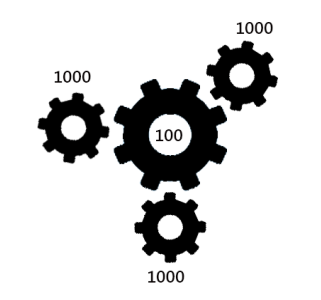
In this system, the driving forces (small gears) must operate at the same speed—for example, 1,000 revolutions per minute—as any discrepancy in speed could lead to the destabilization (or collapse) of the entire system (so that it is considered a constrained system). Additionally, the output speed at the central gear is 100 revolutions per minute (with the final output representing the average of those driving forces).
Conversely, regarding "Technique 3"—and drawing on the concept of free systems (such as magnetic or hydraulic gear systems)—a free hydraulic gear system, for instance, can consist of three small hydraulic gears (or pumps) driving a large, central hydraulic gear (impeller), as the following:-
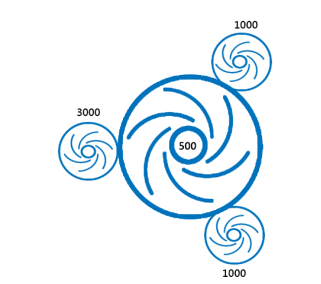
In this free (unconstrained) system, we find the potential for the participation of various driving forces—characterized by differing speeds and torques—acting independently to contribute to the final torque and speed output (which represents the sum of these forces).
"One physics, Different results."
Evaluation:
We conclude from the above and evaluate the importance of Technology3 through: -
- Achieving technical abundance, which is accompanied by an abundance of resources that meet our needs and even the needs of future generations after us.
- Bridging the technical gap to ensure the continuation of our technical journey and our progress towards the future (with highly effective and efficient technologies).
- The possibility of achieving meaningful application of large, important and urgent solutions, such as solutions to major and worsening climate change problems.
- Achieving high energy efficiency, ensuring that we move towards a new era of clean energy (with realistic and even imaginative options).
- Unleash new and exceptional technical capabilities*. Achieve new and different management of important resources such as water, energy, transportation...etc.
* The new capabilities can be summarized with the possibility of building integrated free Motion-Flow systems that achieve technical effectiveness (high speed - torque) and operate beyond a barrier of 10.000 (with speed S, torque T, and high flow Q of more than 10,000 RPM, N.m, m3/s/m/h/d). These new capabilities that can be described as (strong-fast) in contrast to the available that are either (strong-slow) or (Weak - fast) and therefore considered exceptional abilities that have many applications, including:
-The ability to desalinate and treat water directly without intermediaries (such as filters, heat, or chemicals). See Water3, Desalination3® and sanitation3.
- The ability to transport gases, liquids, and water at high density and speeds over long distances, vertically or horizontally. See Rapid Pumping3 and flow3 ®.
- The ability to obtain massive amounts of cheap, clean, and sustainable energy (From Traditional, Renewable or even Newables® sources).
- The ability to quickly and practically address large-scale and escalating problems such as climate change. See Climate3 and Air3 treat System®.
- The ability to address scarcity and achieve abundance of critical resources such as water, energy, food, and more. See Plant3® and Sorbits®.
- The ability to build Free=Motion®(FM) technologies (with high speed and torque). See Motor3®. and Gear3®
- The ability of addressing emissions from the transport sector and developing clean and new means. See Ship3® , Plane3®, Carriers®, and City3®.
- The ability to open up new horizons in vast space. see the Spacecraft Project®.
Conclusion:-
With a global deficit (gap) in meeting all our needs for resources such as water, energy, food, transportation, etc., and in light of the global trend to rely more on clean energy (and the increasing role of electrical energy at the expense of others such as combustion energy in transportation, industry, agriculture, etc.), Technology3 works (with its specialization in motion-flow) and through its methodology (FST-MGQ) , concepts (most notably the principle of Free=Motion(FM)®) and its innovative technologies, to represent practical solutions (with High feasibility and efficiency) that works to address the technical deficit (and achieve technical productivity, effectiveness and efficiency), which achieves new and optimal management of resources (and achieves abundance that ensures the meeting of not only our needs, but even the needs of coming generations) powered by high efficient and innovative energy (ranging between reality and imagination). It also helps us stand more firmly and at a lower cost in the face of major challenges such as climate change, and paves the way for achieving dreams that may seem far-fetched, such as the dream of the clean (electric) plane and ship. It also represents a road map for a quick, easy and secure transition towards a more abundant, peaceful and sustainable future.